


If you open up one of those screaming skeletons, you won’t find a ghost inside, but a small circuit board. Halloween decorations that react as you walk past, flameless flickering candles and lights that change colour with the music would be impossible without semiconductors. Some even use the same technology that turns on the lights in an office corridor or triggers a burglar alarm.
A few weeks ago, at MicroNanoSpain we looked at the chips hidden in the 12 October military parade. This time, we’re swapping armoured vehicles for pumpkins. We’ll follow a typical Halloween night, from the doorbell to late-night ghost hunting, to answer one question: which semiconductors are hiding in Halloween, and what do they actually do?
How do Halloween decorations know you are there?
Many motion-activated Halloween decorations use a passive infrared sensor, or PIR. It doesn’t emit anything. It simply detects the infrared radiation given off by every object: the hotter an object is, the more it emits. A person walking past is a moving heat source, exactly what the sensor is waiting for.
The sensor is a small metal can with a window on top, usually made of coated silicon, a material that looks opaque to us but allows infrared radiation through. Behind it is a pyroelectric crystal that generates a tiny electrical charge when its temperature changes. The sensing element is divided into two halves whose signals cancel each other out. As you walk past, one half detects your body heat before the other, so these decorations respond to movement rather than someone standing still.
The faceted plastic dome in front acts as a set of Fresnel lenses that divide the surrounding space into detection zones. Inside the metal can, a transistor conditions the crystal’s extremely weak signal so that an inexpensive chip can turn it into a clear message: ‘someone is here’. A microcontroller then activates the sound chip, which plays the scream stored in its memory.
It’s the same type of sensor that switches on corridor lights when you enter and monitors many home alarm systems.
How does a flameless LED candle flicker?
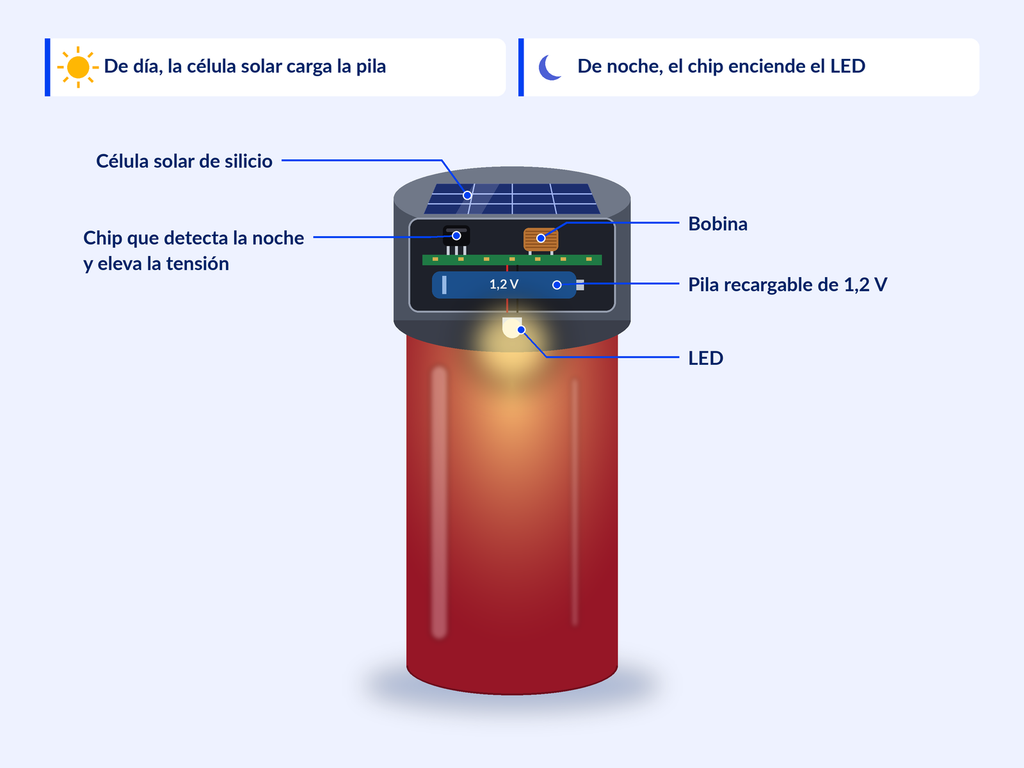
The light from an LED candle already comes from a semiconductor. An LED consists of two layers of semiconductor material with different electrical properties. When current flows across the junction between them, electrons and holes recombine and release energy as light, whose colour depends on the material used.
The surprising part is the flicker. In many LED candles, the flame effect is created by a tiny integrated circuit inside the LED itself, right next to the chip that emits the light. People who have examined these LEDs under a microscope have found both chips inside the same transparent package, connected by wires thinner than a human hair.
This circuit varies the current in a pseudorandom pattern that our eyes interpret as a living flame. In one of these LEDs studied in detail, the sequence did not repeat for at least four minutes. Some newer models go a step further and integrate a tiny microcontroller into the LED, even adding a timer. In other candles, a separate chip on the circuit board produces the flicker.
And because there is no flame, these candles can be placed inside a paper lantern or next to a costume without the risks of fire. Alongside traditional wax and oil lamps, there are LED and solar-powered versions that do not blow out in the wind and need no fuel refills.
Why does blacklight make everything glow?
Blacklight at Halloween parties and haunted attractions is ultraviolet light, and today it usually comes from LEDs. For decades, these lamps were fluorescent tubes made with dark filtering glass. Ultraviolet LEDs emit near-ultraviolet light, most of which is invisible to our eyes, so we see only a faint violet glow from the lamp.
The effect appears when this light reaches certain materials. Optical brighteners in white clothing, quinine in tonic water, highlighter ink and fluorescent face paint absorb ultraviolet radiation and re-emit it as visible light, making them appear to glow in the dark.
These LEDs are made with gallium nitride and its alloys, semiconductors whose bandgap allows them to emit blue and ultraviolet light. Red and green LEDs had existed since the 1960s, but developing an efficient blue LED took roughly three more decades of work with this material.
That work earned Isamu Akasaki, Hiroshi Amano and Shuji Nakamura the 2014 Nobel Prize in Physics and paved the way for the white LED lighting we use every day.
Gallium nitride also has a life beyond the dance floor. Today, it is found in many compact fast chargers for phones and laptops, a reminder that the material lighting up a haunted attraction is also a power electronics material.
What do ghost-hunting cameras actually measure?
Ghost-hunting gadgets are full of semiconductors, but they measure physics, not paranormal phenomena. The two mainstays of any amateur investigation are thermal cameras and night-vision cameras, each capturing a different type of light that our eyes cannot see.
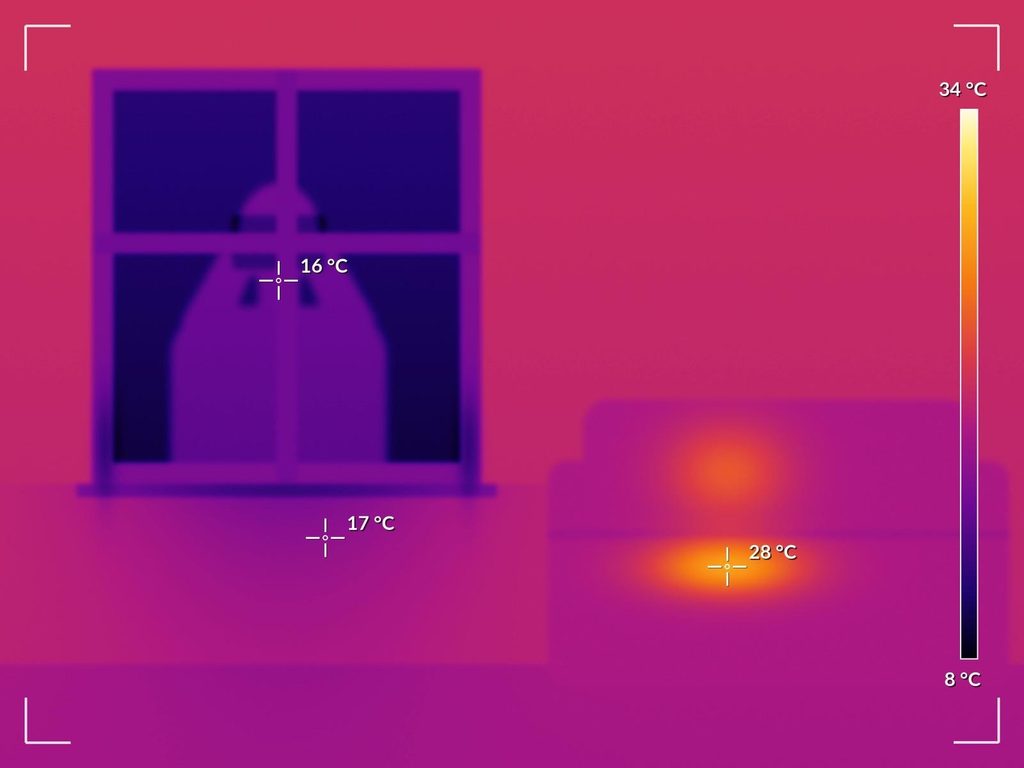
A thermal camera does not see ghosts, or even the temperature of the air. It detects the long-wave infrared radiation emitted by surfaces using a sensor called a microbolometer: a grid of tiny elements built on a silicon chip. Each element warms slightly when this radiation reaches it, changing its electrical resistance. The electronics then turn these changes into an image in which software assigns a colour to each temperature.
That is why the cold spots and warm shapes in so many videos usually have a very down-to-earth explanation. What the camera reads is the combined energy that a surface emits, reflects and transmits, so a draughty window, a patch of damp or the heat someone has left on a sofa can look like a presence. Ordinary glass blocks this radiation, and shiny surfaces can reflect nearby heat sources, sometimes including the person holding the camera.
Night-vision cameras work differently. The CMOS sensors in cameras can detect near-infrared light as well as visible light. Night-vision models therefore do without the filter that ordinary cameras use to block it, and illuminate the scene with infrared LEDs, another semiconductor device. The most common emit at around 850 nanometres, which explains the faint reddish glow we see on security cameras.
As for the famous orbs floating through these recordings, they are usually dust particles or insects very close to the lens, reflecting that same infrared light.
What do all these Halloween chips have in common?
From the doorbell to ghost hunting, Halloween night is full of semiconductors performing very different jobs. Some detect heat or light, while others store sounds, generate patterns or emit light our eyes cannot see. Most are mature, inexpensive technologies manufactured in enormous quantities, which is precisely why they go unnoticed.
A chip doesn’t have to be cutting-edge to be indispensable.
Sensors, microcontrollers, LEDs and packaging are part of the same value chain as the most advanced processors, a chain that the European Chips Act aims to strengthen. MicroNanoSpain contributes to this as a national competence centre that provides a single point of access to design and manufacturing capabilities and connects universities, research centres, industry and infrastructure.
And you, how many chips are lurking in your home this Halloween? The next time a skeleton screams as you walk past, you will know there is no ghost inside, just a sensor, a microcontroller and a sound chip.