

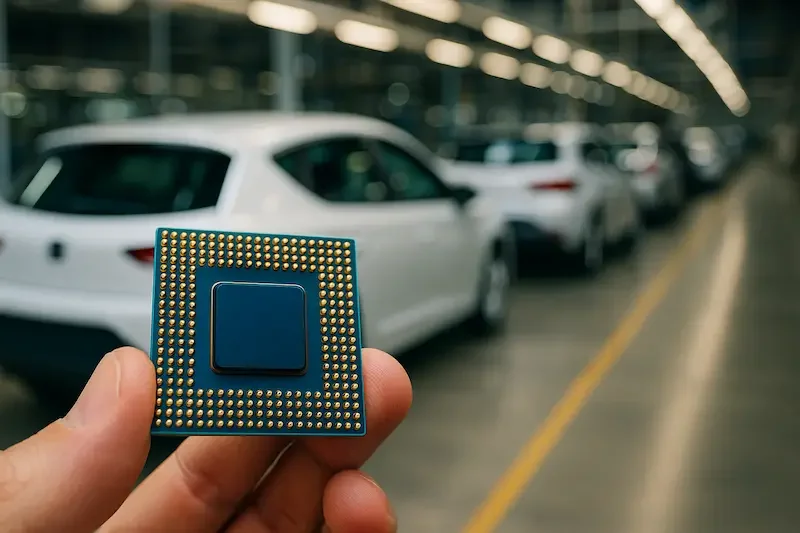
When we explain what semiconductors are and what they are used for, we usually list all the everyday things that need chips to work. Smartphones, microwaves, computers… even some modern frying pans.
That list also includes the place where many people spend several hours a day, sitting in traffic on the way to work or class, or taking their children to school. Of course, we are talking about the car.
Modern cars rely heavily on chips, with each vehicle containing between 1,000 and 3,000 of these tiny circuits. In fact, we have already experienced the impact of the semiconductor industry on the automotive sector.
The semiconductor supply crisis that began in 2020 temporarily brought car production to a halt, forcing some factories to close, raising manufacturing costs (and, consequently, the prices of both new and used cars), and causing significant losses for workers.
The high demand for automotive semiconductors is due to the fact that they have become one of the industry’s strategic pillars, enabling remarkable technological advances that we will explore in this article.
What do power chips actually do?
Some typical examples of chips in cars are those used in climate control, advanced driver assistance systems (ADAS), airbags, anti-lock braking systems (ABS) and even remote door unlocking. However, these small components do much more than switch things on, measure values or issue alerts.
If you have ever searched for a “power chip” for your car, you have probably come across garages promising a few extra horsepower by reprogramming the engine control unit. But in the semiconductor industry, power electronics means something else (and something much more interesting): it refers to the components that manage energy within the vehicle, determining how much reaches each system, in what form and at what time.
If processors are the car’s brain, power chips are its muscles. The key component is the power transistor, which acts as a switch capable of turning on and off thousands of times per second. By combining these switching operations, it is possible to convert direct current into alternating current, increase or decrease voltage, or precisely regulate the energy supplied to a motor.
In an electric car, the clearest example is the traction inverter, which converts direct current from the battery into the alternating current needed by the motor. It also works in the opposite direction: when braking, the motor acts as a generator and the inverter returns some of that energy to the battery. This is known as regenerative braking.
But it is not the only example. When we charge a car at home or at an AC charging point, the onboard charger converts electricity from the grid into direct current for the battery. The DC-DC converter then reduces the high voltage of the main battery (usually 400 or 800 volts) to the 12 or 48 volts used by the lights, display or electric windows.
Nor do you need an electric car to find power electronics. Combustion-engine vehicles also use it in systems such as start-stop, 48-volt mild hybrids, electric pumps and fans, and electric power steering, which we will discuss later.
The major advantage of these systems is efficiency: every energy loss avoided translates into greater range or lower consumption. However, they operate at high voltages and currents and generate heat, so they must be carefully designed and supported by cooling systems that ensure reliability throughout the vehicle’s lifetime.
Chips make it possible to drive “even with your eyes closed”
If power electronics are the car’s muscles, we still need to talk about its nervous system: the chips that allow it to perceive what is happening around it and decide how to react. This is where the rapid expansion of artificial intelligence opens up a whole universe of unexplored possibilities.
One of those possibilities, although not entirely new, has been refined thanks to what is known as physical AI. We are talking about autonomous cars.
But first, what is physical AI?
Physical AI does more than process data like traditional AI. It uses vision, sound and touch to gather information, make decisions and adapt to changes in real time. Its responses take place through a physical body.
An autonomous car is, essentially, a vehicle capable of observing its surroundings, interpreting what is happening, making decisions and controlling the steering, accelerator and brakes without constant human intervention, within the limits for which it was designed.
As NVIDIA explains, the arrival of robotaxis is one of the most visible examples of so-called physical AI: systems that do not merely analyse information but interact with the real world.
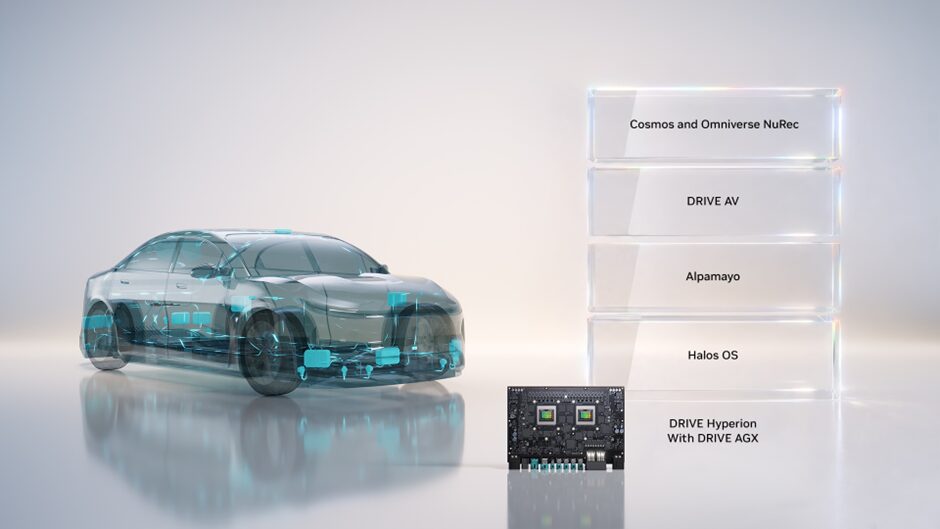
What makes this ability interesting is that it does not depend on artificial intelligence alone. Behind it lies a complex combination of sensors, processors, microcontrollers and electronic systems that allow the vehicle to turn information about its surroundings into real movements.
It all starts with the vehicle’s senses, each of which relies on a different type of semiconductor. Cameras use CMOS image sensors, chips that convert light into electrical signals and make it possible to recognise traffic signs, lanes or pedestrians. Radar uses radio-frequency chips that emit waves (usually in the 77 GHz band) and analyse their reflections to calculate the distance and speed of other objects, even in rain or fog.
LiDAR, meanwhile, combines laser emitters and photodetectors to measure the time it takes for light to return and build a three-dimensional map of the surroundings. These technologies are joined by ultrasonic sensors, useful for low-speed manoeuvres, and MEMS inertial sensors (accelerometers and gyroscopes), which work alongside satellite navigation to help the car establish where it is and how it is moving.
None of these senses is sufficient on its own. A camera distinguishes colours and shapes but struggles in low light; radar is less affected by fog but provides less detail. That is why the vehicle combines all this information in a process known as sensor fusion.
Continuously interpreting such a large volume of data and deciding how to act requires high-performance processors. This is where systems-on-chip (SoCs) come in, integrating CPUs, GPUs and specialised artificial intelligence accelerators, supported by memory capable of transferring large amounts of information at high speed.
These semiconductors make it possible to run AI models that identify objects, estimate trajectories, predict movements and select driving manoeuvres.
All of this requires data to be processed in real time. The lower the latency between detecting a hazard and the vehicle’s response, the more room the system has to act.
Once a decision has been made, the most delicate part remains: turning it into a real movement. The central computer does not turn the steering wheel or press the brake itself. Instead, it sends commands (such as the desired steering angle or deceleration) through the vehicle’s communication networks to the electronic control units (ECUs) of each system.
Each ECU contains a microcontroller that continuously runs control algorithms: it compares the requested action with measurements from its own sensors and calculates how much force must be applied. The command reaches a power stage, made up of gate-driver circuits and transistors, which supplies the electric power-steering motor or the actuator that generates braking pressure.
It is those motors and actuators that ultimately turn the wheels or bring the vehicle to a stop.
Because a failure in this chain could have serious consequences, these systems are designed in accordance with functional safety standards such as ISO 26262 and often include redundancy: duplicated circuits capable of taking over if something fails.
Semiconductors are present throughout the entire chain: from the sensor that detects an object to the circuit that helps execute the manoeuvre.
Ultimately, the autonomous car is one of the best examples of how semiconductors bring artificial intelligence into the physical world. It is not enough for a vehicle to recognise a traffic light or a pedestrian: it must interpret the situation, anticipate what might happen and turn a computing decision into a safe action on the road.
And that whole process begins, develops and ends with the help of chips.
What comes next? Flying cars?
After years in our collective futuristic imagination, it seemed that almost every generation had accepted that flying cars were not something they would ever see. Yet, although they are not available for everyday use, we already have some vehicles that come close.

One of the most talked-about recent developments is the new Tesla Roadster, an electric supercar unveiled in October 2026 that, in its most extreme versions, incorporates technologies developed alongside SpaceX, such as cold-gas thrusters, as well as a system capable of generating considerable suction beneath the vehicle. Elon Musk has set 2028 as the target for the start of production, although for now this remains a goal and the car is still under development.
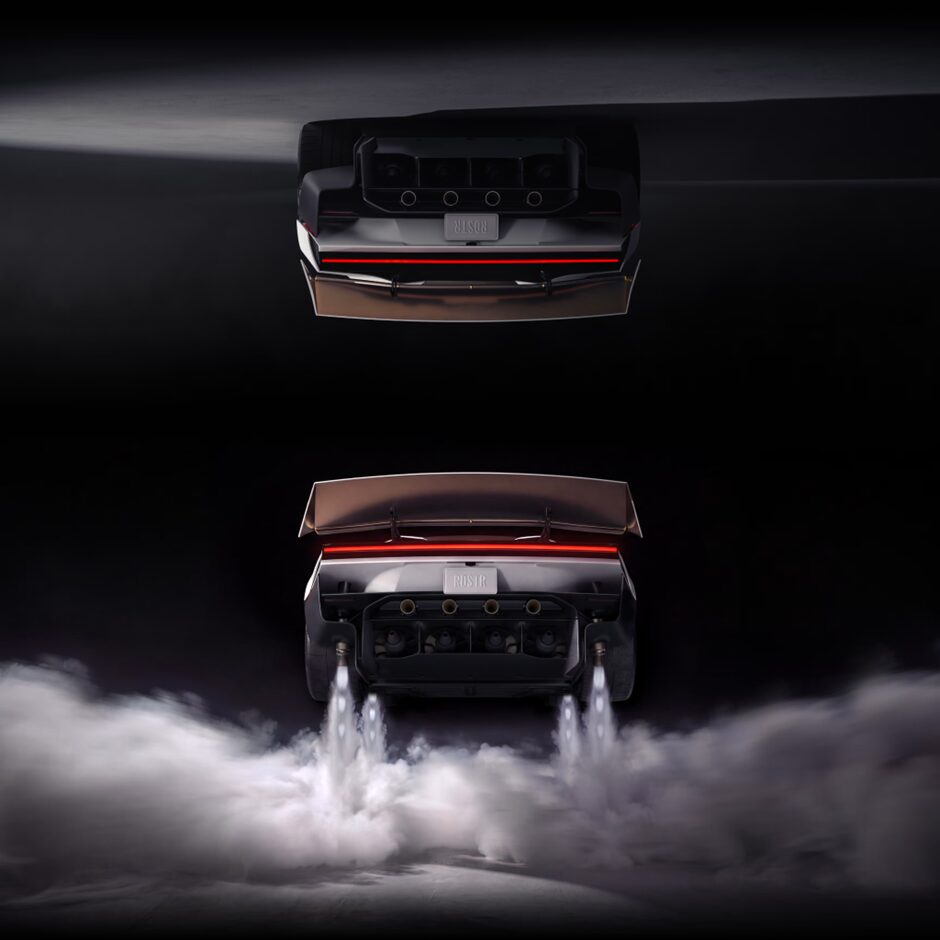
Reaching such high speeds in so little time is, above all, an achievement of mechanical and electrical engineering, involving the motors, battery, weight, aerodynamics and tyre grip. Even so, there is one component in that chain in which semiconductors take centre stage.
It is the traction inverter, which we discussed at the beginning. This device uses power transistors to convert direct current from the battery into controlled alternating current, suitable for AC motors, which are the most common in today’s electric vehicles (DC motors, less frequently used for traction, are managed by other types of converters).
Through very rapid electronic switching, the inverter regulates the current amplitude, frequency and phases supplied to the motor.
There is no single type of transistor for this task. For years, inverters mainly used silicon IGBTs, which now coexist with silicon carbide (SiC) MOSFETs and, in some applications, gallium nitride (GaN) transistors. Each technology has its strengths: SiC has become widespread in high-voltage traction inverters, while GaN stands out in compact converters operating at very high frequencies, such as some onboard chargers.
In this article, we will focus on SiC.
Silicon carbide is particularly interesting for traction because it makes it possible to manufacture devices that withstand high voltages, reduce certain energy losses and improve system efficiency.
And what about the virtually instantaneous response to the accelerator? That has more to do with the nature of the electric system itself: energy reaches the motor through cables without depending on a complex sequence of mechanical processes, and the electric motor delivers torque from a standstill. Power electronics does not create that responsiveness, but it allows it to be exploited by precisely adjusting the torque produced by the motors.
This does not mean that chips generate acceleration on their own: they control the energy supplied to motors whose power, together with the battery, transmission and tyre grip, determines the vehicle’s performance.
Nor is this a new technology. Electric and hybrid vehicles from the 1990s, such as the GM EV1 (1996) and the first Toyota Prius (1997), already used inverters to control their motors. What has changed is the materials and the scale: in 2018, the Tesla Model 3 became one of the first mass-produced cars with an inverter based on SiC modules supplied by STMicroelectronics.
But speed takes a back seat to the most striking innovation in the version presented in October 2026: its system of electric fans and underbody sealing.
The system works by extracting air from beneath the car to reduce pressure in that area. The pressure difference generates a force that pushes the vehicle towards the ground. Tesla claims that the system can generate enough suction to hold the car upside down, even when stationary.
The principle is purely aerodynamic. In fact, motorsport explored it back in the 1970s with so-called fan cars, such as the Chaparral 2J. What semiconductors provide today is control.
The fans are driven by electric motors powered by their own power electronics, while microcontrollers regulate their speed and coordinate active aerodynamic surfaces, such as the rear wing.
In this way, electronics make it possible to control the suction force and adapt the car’s aerodynamic behaviour to different situations.
Tesla has also unveiled versions of the Roadster equipped with cold-gas thrusters, a technology different from conventional electric propulsion that the company reserves for its most extreme, limited-production variants.
Instead of relying solely on tyre grip, these devices expel pressurised gas to generate thrust through the principle of action and reaction. Once again, the underlying physics is mechanical, but the actuators that open and close the gas flow are electric and allow very rapid adjustments.
Another notable innovation is steer-by-wire.
In a conventional system, the driver turns the steering wheel and a mechanical connection transfers that movement to the wheels. Since the late 1980s, many cars have also incorporated electric power steering (EPS): the mechanical connection remains, but an electric motor controlled by an electronic control unit helps the driver steer. Today, this system is found in most new cars and forms the basis of features such as lane-keeping assistance.
Steer-by-wire goes one step further and eliminates that mechanical connection. Sensors and electrical signals interpret movement of the steering wheel, and a control system processes those signals and instructs the motors responsible for turning the wheels. This makes it possible to electronically adapt steering response to different speeds and conditions. Tesla already uses this technology in the Cybertruck.
Semiconductors fulfil three fundamental roles: detecting movement through sensors, processing commands with microcontrollers and controlling electric actuators through power circuits.
The Tesla Roadster illustrates an important evolution in the automotive industry: semiconductors are no longer used solely for auxiliary functions but have become fundamental elements in controlling a vehicle’s dynamic behaviour.
Is the future of cars already here?
While we continue waiting for some of science fiction’s promises, others are already beginning to become reality.
But behind every advance lies a protagonist that rarely appears in car advertisements: semiconductors. From the chips that allow a vehicle to interpret its surroundings to the transistors that regulate the energy supplied to its motors, the evolution of the car is increasingly tied to advances in microelectronics.
And although we still do not know whether we will one day fly to work, perhaps the question is no longer how far the cars of the future will go, but how far semiconductors will allow us to go.