
The I Matchmaking Day by MicronanoSpain, a day conceived as a meeting point for the Spanish ecosystem of semiconductors, brought together companies, universities, technology centers, and organizations linked to microelectronics and semiconductors.
During the meeting, the participating entities presented some of the technologies and projects they are working on.
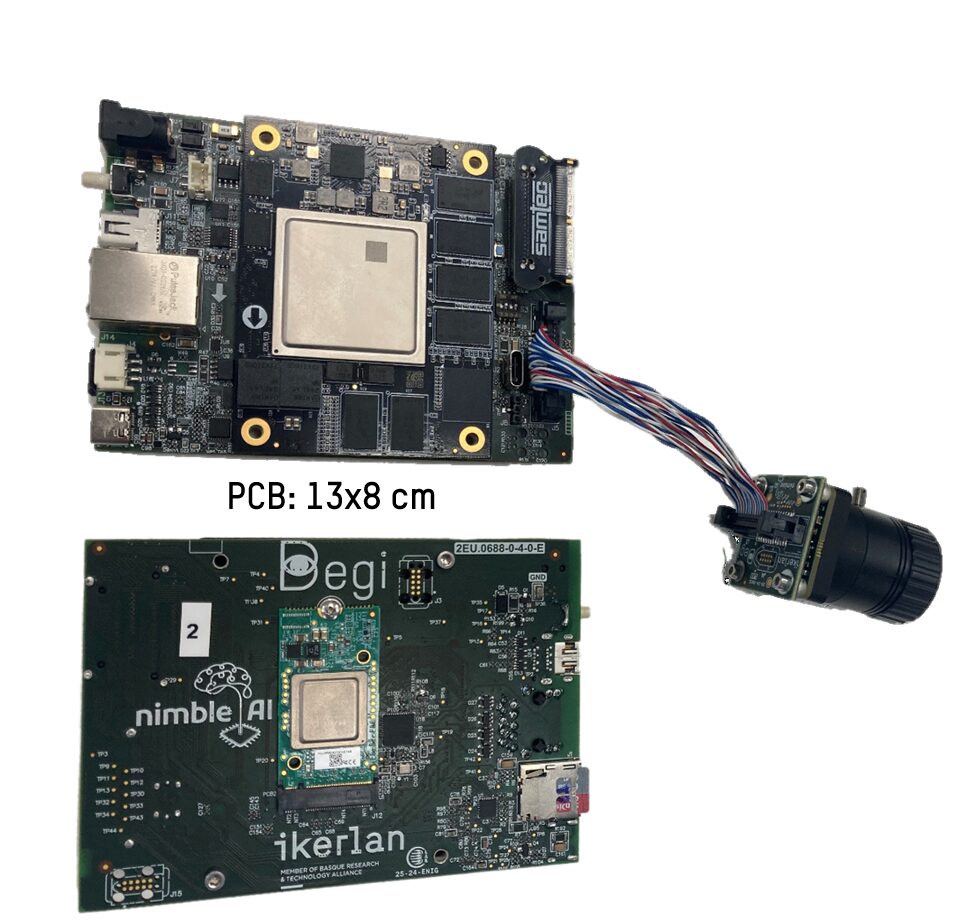
Among them was Begi, a solution developed by IKERLAN It is inspired by the visual system of insects to help intelligent robots and machines interpret the movement in a faster, more accurate, and efficient way.
Begi moves an idea inspired by biology to artificial vision: register only what changes to react earlier and consume less energy.
IKERLAN, technology oriented to the needs of the industry
Ikerlan is a technology center that has been working since 1974 on the generation and transfer of knowledge towards companies. Integrated in the Mondragón Corporation and a member of the Basque Research and Technology Alliance, it develops solutions aimed at sectors such as advanced manufacturing, mobility, energy, electronics, or artificial intelligence applied to industry.
This connection between research and industry is very present at Begi, a project that combines advanced sensors, microelectronics, and algorithms to respond to one of the great challenges of physical artificial intelligence: getting machines to understand what is happening around them and react in real time.

A camera that does not need to capture complete images
Conventional cameras generate a succession of complete photographs, although most of the visual scene has not changed. As a result, much of the time and energy used in processing this data is not useful.
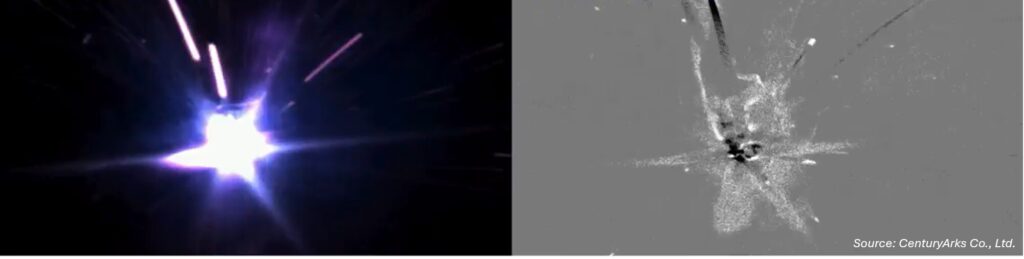
Begi uses a different working principle: its neuromorphic sensor only records the variations of luminous intensity that occur in each pixel as a consequence of the movement of objects, similar to the operation of the retina’s photoreceptors.
Thanks to this operation, Begi acquires a much lower volume of data than a conventional camera, reducing the energy consumption associated with its processing and being able to detect extremely fast movements with a microsecond latency.
In addition, by functioning each pixel independently, it avoids much of the blur that appears when recording objects at high speed and can operate with different levels of light in different regions of the scene.
Less data does not mean less information: in neuromorphic vision, it can precisely mean the information that matters.
Insect inspiration to understand space
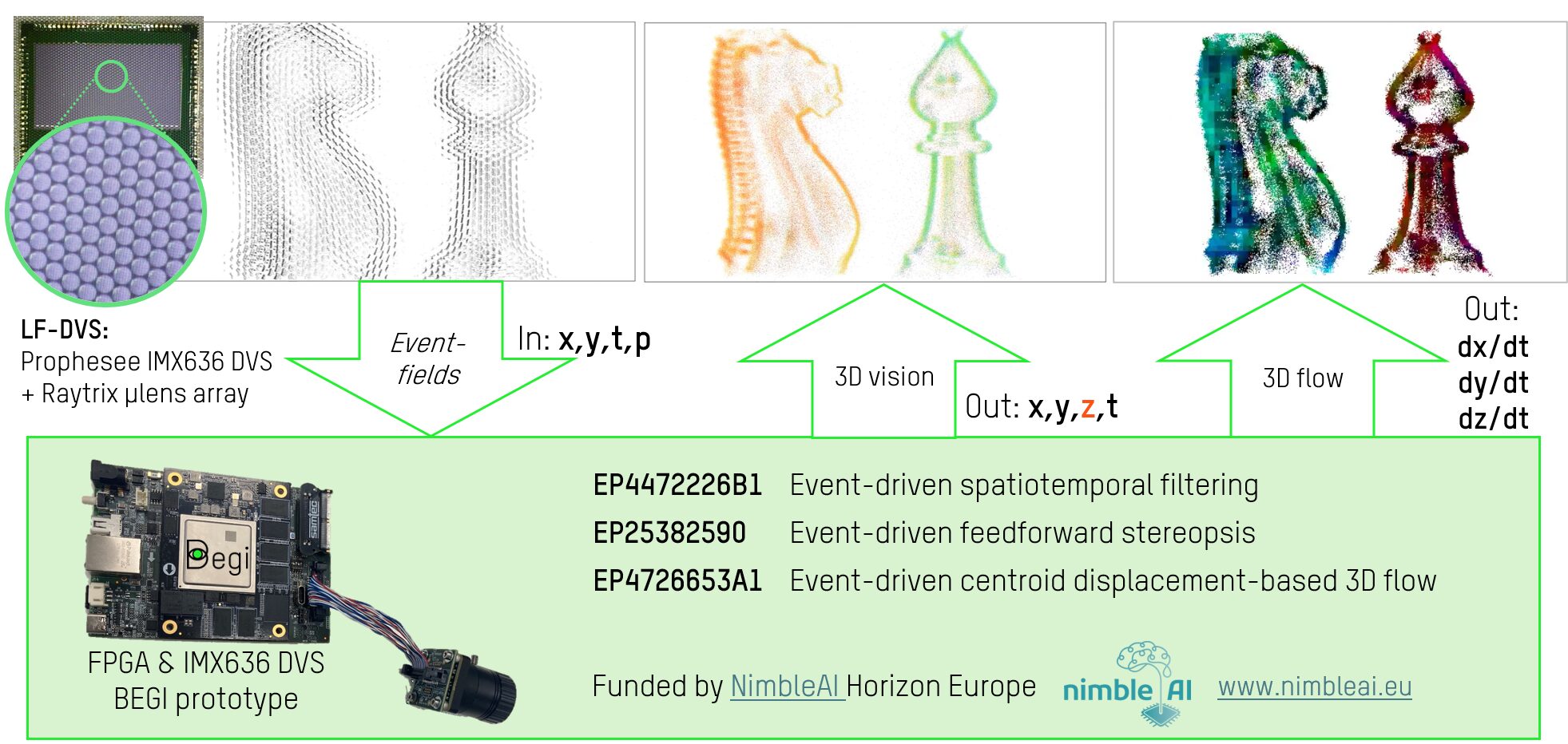
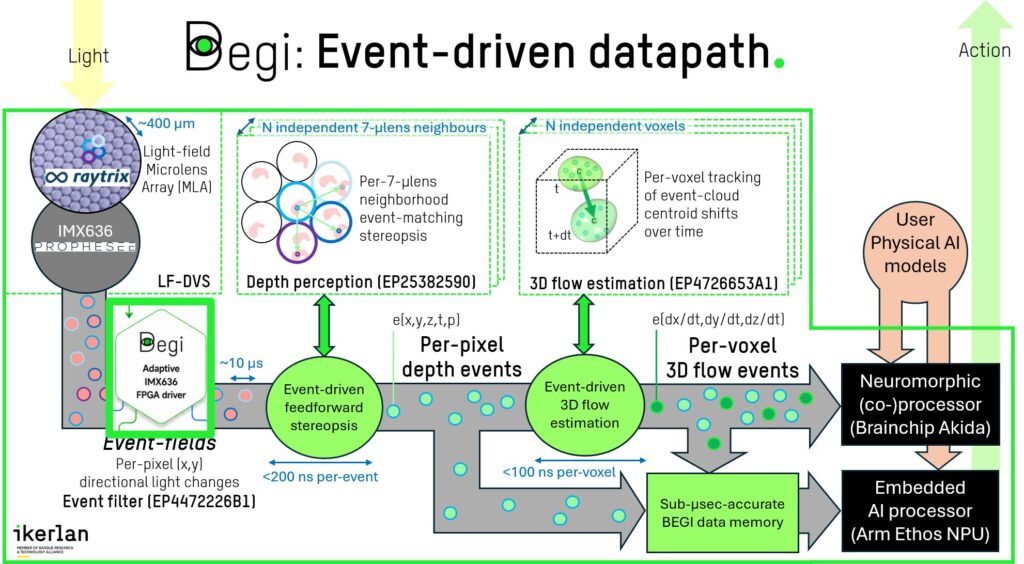
Developed by Ikerlan, Begi combines a microlens matrix with a neuromorphic sensor to capture the direction of light and perceive the world in 4D: position (x, y, z) and time. Inspired by the compound eyes of insects, it is a passive, monocular system without moving parts that natively estimates the position and movement of objects in metric units, without the need to emit light to the environment.
This metric information allows you to anticipate trajectories, estimate collision times, avoid obstacles and ensure safe interactions between machines, people and other moving elements.
In addition, its configurable optical stack adapts the working range from a few millimeters to several meters, which makes Begi a versatile solution for industrial and autonomous robotics applications.
Less information to respond faster
One of Begi’s main competitive advantages is its ability to process information directly on the device itself. The prototype developed by Ikerlan integrates the neuromorphic vision sensor with a patented FPGA-based processing architecture, optimized to exploit the advantages of neuromorphic vision and minimize latency and energy consumption.
This technology has been developed within the framework of the European Nimbleai project, whose objective is to promote a new generation of more efficient artificial intelligence based on neuromorphic technology.
As a demonstration, Ikerlan’s team used a fan rotating at about 1,000 revolutions per minute. Begi was able to rebuild the 3D geometry of the blades in real time and accurately estimate its turning speed, an impossible task for conventional vision systems due to the high speed of rotation and extremely difficult even for high-speed cameras, whose huge volume of data makes processing difficult. in real time.
The practical advantage is in reacting more quickly using much less data.
What can this technology be used for?
Neuromorphic vision can play a relevant role in the development of the so-called physical artificial intelligence, that is, systems capable of perceiving the real world, making decisions, and acting on it.
Among its possible applications is the navigation of mobile robots and drones, which need to detect obstacles and anticipate movements. It can also be useful in autonomous vehicles, driving assistance systems, robotic arms, or machinery that works together with people.
In industry, Begi could facilitate monitoring of high-speed moving components, control of manufacturing processes, or early detection of anomalies in engines, turbines, and other rotary elements.
Its reduced consumption and its ability to process information locally can also favor its incorporation to autonomous devices with limited energy resources or privacy requirements.
The practical advantage lies in being able to react more quickly using much less data. This would result in safer robots, more efficient industrial machinery, and perception systems capable of working in conditions where a traditional camera would have difficulties.
From research to new industrial solutions
Begi is currently in the development and technological validation phase. Its evolution towards the market is based on a model of co-development with companies, which will allow to specialize the technology for different niches of application and accelerate its industrial adoption.
Its potential has already been recognized by the industry. The report Neuromorphic Computing, Memory and Sensing 2024 of Yole It identifies Begi, the Nimbleai project and 3D neuromorphic vision as disruptive technologies and places their maturity for industrial applications from 2027.
Research on neuromorphic sensors targets machines capable of perceiving movement with closer precision and efficiency to biological systems.
Through initiatives such as the I Matchmaking Day, MicronanoSpain It favors the knowledge and the connection between the agents of the Spanish ecosystem of the semiconductors, giving visibility to capacities that can become future collaborations, industrial developments, and applications with an impact on society.
Photos are the property of https://www.ikerlan.es/